

With Halloween upon us, this season has been about scaring voters about socialism, communism and Marxism–in some cases they are presumed to be indistinguishable.
On the eve of the country’s 250th birthday celebration, President Donald Trump traveled to land once promised to the Sioux Indians that now shows the busts of four European-descended American Presidents, otherwise known as Mount Rushmore.
In that speech’s dark moments, he focused on a growing threat of communism that harkens back to a time more than 70 years ago, when Senator Joseph McCarthy adeptly used the Red Scare to extend the work of the House UnAmerican Activities Committee to investigate alleged communist infiltration into society.
Trump remarked, “The American founding represents the best ideas and traditions in history by the best people, like you. You can be loyal to Karl Marx or you can be loyal to America. You can be a communist or you can be a patriot. You cannot be both. As for those who pedal Marx’s lies about our heritage, who tell our children that we live on stolen land or that our heroes were oppressors.”
Trump was not alone, major ,edia outlets are full of concerns from those opposing Trump that the Democratic Socialists of America are connected to communists and have crazy ideas–and how imperative it is for the Democratic Party to stop these insurgents or face electoral defeat.
Democratic Michigan Senate candidate Abdul El-Sayed is progressive, not a self-described socialist, but he, in many ways, represents a test, as he advocates Medicare for All. Though as a Muslim and harsh critic of Israel’s systematic human rights violations–he’s been the subject of vile Islamophobia, including President Trump calling him a jihadist, and some prominent Michigan Jews being skittish about his candidacy, so he’s certainly not solely being evaluated on Medicare for All.
Not surprisingly in this context Americans generally have a negative view of socialism, namely among independents, Republicans and older voters. Younger voters and Democrats are more positive (see graphs below).
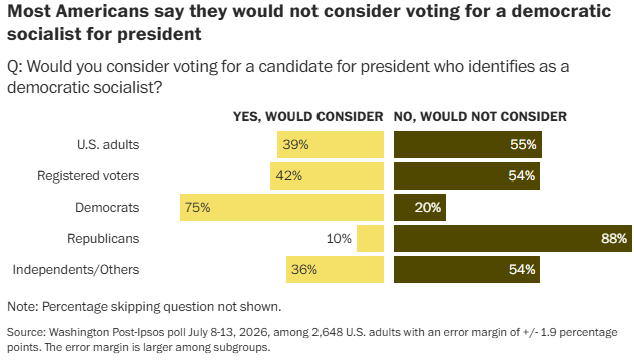
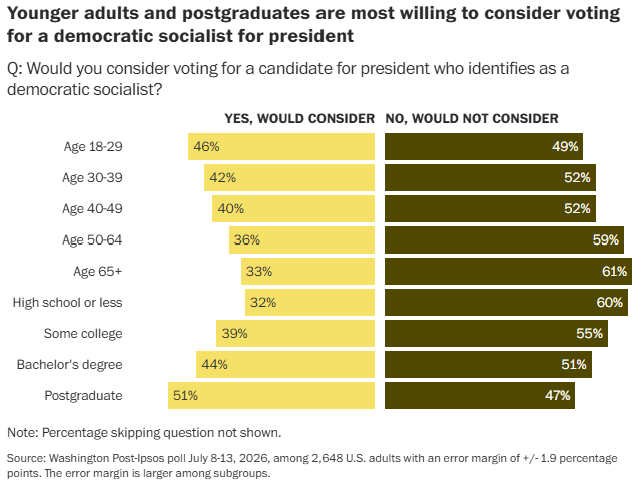
Ask folks to define socialism or communism and many opponents get tongue-tied.
Jordan Kepler of the Daily Show asked Trump supporters to define communism and got results (at least in what was included) from “I really can’t give you a definition” to essentially some idea of losing freedom to “this is the best country in the world and we don’t want to change it” followed by stone silence when pushed to define communism.
Vice President J.D. Vance gave it a completely different twist when asked to define socialism, “oh, man, I guess, it’s a hard term to define these days. I don’t know what the term means anymore. I think in reality what it actually means in the American context is that you want to replace American workers with foreign workers, and you want boys to play in girls’ sports.”
Karl Marx (1818-1883) couldn’t have said it better (I’m joking if you don’t notice sarcasm).
Marx’s desire to overthrow the bourgeoisie (capitalist ruling class) and co-authorship in 1848 of The Communist Manifesto inspired subsequent revolutionaries like Vladimir Lenin (1870-1924). This often leads us to focus on Marx’s weakness, instead of his strengths. Marx’s real expertise was not communism–a utopian vision of society–but his analysis of capitalism. The deftness of Marx’s criticism of those enriched through the exploitation of the masses in the industrial revolution stands in sharp contrast with his relative naivete about the process of societal change needed to build an alternative society. George Orwell (1903-1950), a staunch democratic socialist, wrote about the dangers of Marxist-Leninist-Stalinist authoritarianism, nicely summarized in his 1945 allegory Animal Farm.

While Marx focused largely on class, today we also know that race/ethnicity, gender, nationality, religion and other identities can become fulcrums of societal divisions. But notably class is often overlooked. We are living in a second gilded age, where the wealth divide is immense. Elon Musk’s net worth is close to a trillion dollars. A trillion is a million times a million. So for someone who has assets worth a million dollars, as about 1 in 6 households do, Musk has a million dollars for each and every one of those dollars. At the same time, this is a country that does not ensure people access to housing, health care or even food. So many people in this country are homeless, struggle to pay rent, forgo medical help due to cost, can’t fill their gas tanks or are food insecure.
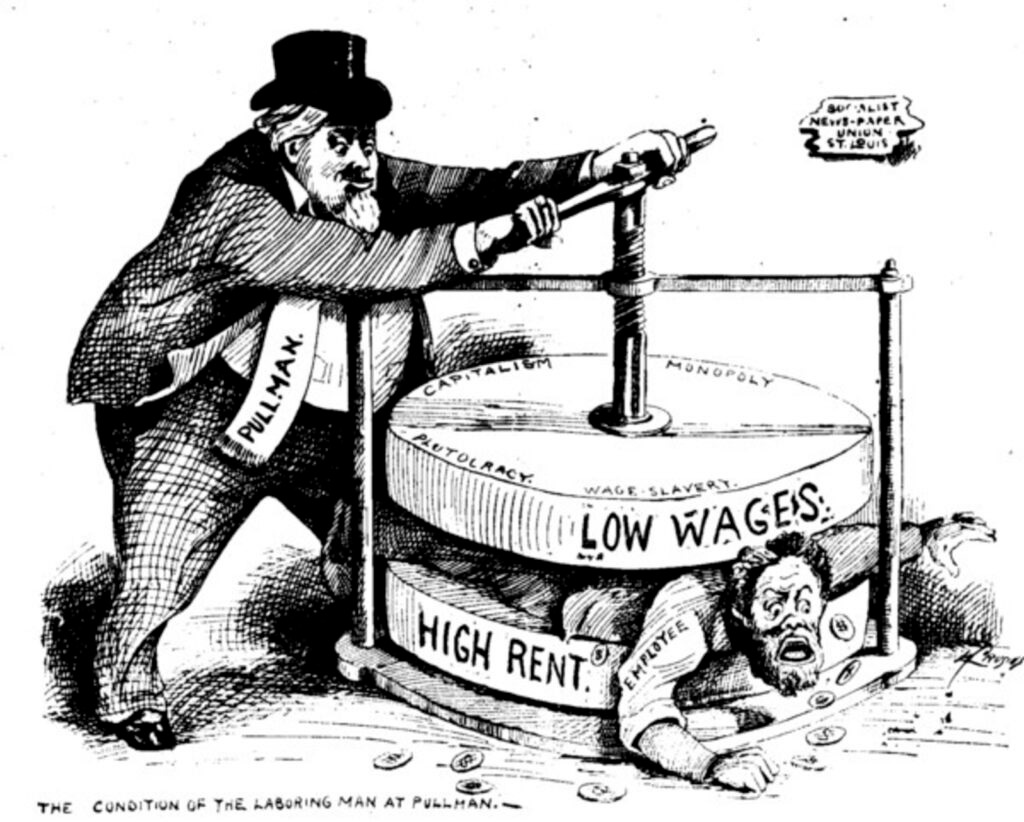
Similar stark differences led Marx to analyze the inner workings of capitalism from his vantage point in London during the industrial revolution. He emphasized that the interests of workers and capitalists are in conflict. Capitalists want to make profits and push workers by paying them less or making them work longer or harder. So in fact the idea of bringing in foreign workers to undermine domestic labor is more consistent with historic capitalism, Vice President Vance, not socialism. Through commodity fetishism people get enamored by the goods but lose track of the labor and the exploitation of that labor which may be behind them. Then they buy the cheapest goods, reinforcing the most exploitative practices.
Capitalism’s contradictory impulses create busts when pushed to its extreme, with very high profits and low wages, workers cannot spend enough and the system crashes. Today we’re seeing record amounts of money invested into Artificial Intelligence software and accompanying hardware (data centers), but profits are lagging and if there’s insufficient profit, it will also collapse. Consequently, capitalism inevitably has boom and bust cycles. But typically when it goes bust, the people hurt the most aren’t capitalists but workers. Recall the bailouts for Wall Street but not Main Street after the 2008 economic collapse.We have socialism for the rich with government bail outs of too big to fail, but do not do likewise for everyone else. Inflating prices today hurts everyone, except those benefiting from inflated stock prices–a much smaller, privileged segment of society.
Much of the 20th century reforms to a fairly unregulated “free” market did not exist in Marx’s time. They have worked to make a boom-bust system, more stable and functional. But we still have intolerable extremes.
These growing intolerable extremes have made candidates successful who are more willing to speak out about the need for fundamental change. That change need not mean the extreme results that were the outgrowth of Marx’s analysis, the proletariat seizing the means of production. History has shown its limitations, both in terms of achieving that end as well as the means to do so. The proletariat may never be ready, which is what led Lenin to envision an intermediary vanguard–which ultimately became its own permanent ruling class, the Communist Party. Seizing the means of production has not led to the intended utopian results either with Cuba being a good illustration (an analysis complicated by its reliance on fuel subsidies from the Soviet Union and later Venezuela combined with ongoing sanctions and interference from the United States). In the United States a sizable amount of Marx’s proletariat form the MAGA political base of the billionaire, graft-centered Donald Trump. But we should not accept that these realities are immutable. We need to find ways to rebalance the scales between capital and labor to enable the benefits of capitalism to be shared more evenly. That’s my understanding of the goals of Democratic Socialism whether one agrees with specific policies advocated for or not.
Though the United States has maintained higher economic growth than other advanced economies, it has consistently failed to find a better balance of shared benefits. So higher growth has not meant the best comparative quality of life, ranking 17th in the Human Development Index.
So in an age where billionaires try and buy elections, a bit more Marxian analysis is patriotic, and so is a bit more socialism unless, that is, you want Social Security benefits to be cut to eliminate its upcoming funding crisis or you want to return to a time when you could be excluded from healthcare coverage due to a pre-existing condition.
You can also read this at my substack and subscribe for future posts.