
During my 25 year career as a teaching professor at Arizona State University, I evaluated thousands of written assignments. The hardest ones were where the student plagiarized as you had to try and document it or when the student did not follow the assignment’s direction very well. Again in the latter case, you need to carefully document how the essay erred. When you give students low grades, you also document as it’s more probable they might complain if they don’t understand the reason.
When a student disagrees with the grade, they can ask a faculty member to re-evaluate their work and sometimes this leads to an adjustment, but usually if that occurs it’s modest. Then there is a formal grade appeal process. The grade appeal leads to someone else or a group of others getting testimony from the student and the instructor and determining a recommended course of action.
As a faculty member when you receive a paper that does not address what was expected, you can consider asking the student to rewrite it, but barring exceptional circumstances to be fair you would have to make that opportunity open to everyone–so it’s not a course of action often done–especially if that’s not clearly detailed as an option in the assignment or the syllabus.
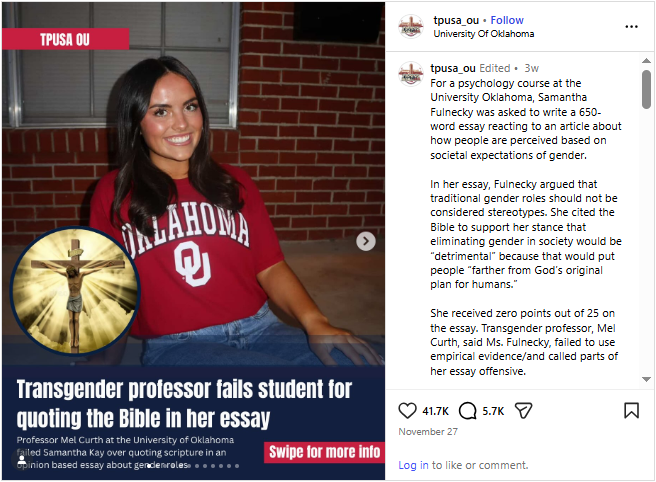
At the University of Oklahoma academics and the place of the instructor was undercut for political expediency due to the fallout created when a student, rather than go through the appropriate procedure, instead decided to post her complaint on social media and it got picked up by Turning Point USA and some Republican politicians, including the Governor of Oklahoma, who turned it into a crusade against the instructor for violating the student’s religious freedom.
The University has now gone to new lows by punishing the instructor by removing them from further teaching. This entire sequence of events is appalling–regardless of your religious beliefs.
The best place to start is to look at the actual paper and assignment.
If I had received this student’s paper and had made the same assignment with the same grading rubric, how would I have handled it? While I would not have given the student a zero (which occurred in this case), I still would have failed the student for failing to adequately detail a level of interaction with the assigned reading and instead substituting a more casual, insufficiently nuanced, reading and a focus on the student’s religious beliefs that had nothing to do with the assignment. This I will demonstrate was not a hard call–and that the University of Oklahoma gave the student a pass and instead punished the faculty member for doing their job is highly disconcerting.
Let’s start with the course PSY2603 Lifespan Development, which is a 200-level (2nd year) course that has as a prerequisite Introduction to Psychology. so students have some general background coming into the course
Next let’s focus on the required reading: Relations Among Gender Typicality, Peer Relations, and Mental Health During Early Adolescence by Jennifer A. Jewell and Christia Spears Brown from the University of Kentucky that appeared in the Journal Social Development in 2014.
Here’s the abstract:
The current study examines whether being high in gender typicality is associated with popularity, whether being low in gender typicality is associated with rejection/teasing, and whether teasing due to low gender typicality mediates the association with negative mental health. Middle school children (34 boys and 50 girls) described hypothetical popular and rejected/teased peers, and completed self‐report measures about their own gender typicality, experiences with gender‐based teasing, depressive symptoms, anxiety, self‐esteem, and body image. Participants also completed measures about their peers’ gender typicality, popularity, and likeability. Results indicated that popular youth were described as more gender typical than rejected/teased youth. Further, being typical for one’s gender significantly predicted being rated as popular by peers, and this relationship was moderated by gender. Finally, low gender typicality predicted more negative mental health outcomes for boys. These relationships were, at times, mediated by experiences with gender‐based teasing, suggesting that negative mental health outcomes may be a result of the social repercussions of being low in gender typicality rather than a direct result of low typicality.
“ Gender typicality” relates to how well a person’s expression of self matches up with gender norms that middle schoolers have learned through socialization and the authors suggest it’s best seen as on a continuum from typical to atypical since there are many nuanced aspects of gender performance.
The next step is to look at the assignment itself:
You must write a 650 word (body of text), double-spaced reaction paper demonstrating that you read the assigned article, and includes a thoughtful reaction to the material presented in the article. Points will be deducted when papers are deficient in any of these areas. I will deduct 10 points if you paper is between 620 and 649 words and I will not give credit for papers under 620 words. Papers not turned in by the deadline will not receive credit.
Please remember that your reaction paper should be a summary but rather a thoughtful discussion of some aspect of the article. Possible approaches to reaction papers include:
- A discussion of why you feel the topic is important and worthy of study (of not)
- An application of the study or results to your own experiences.
There are other possibilities as well. The best reaction papers illustrate that students have rad the assigned materials nad engaged in critical thinking about some aspect of the article.
GRADING: Reaction papers are graded on a 25-point scale, and evaluated based on the following:
- Does the paper show a clear tie-in to the assigned article? (10 points)
- Does the paper present a thoughtful reaction or response to the article, rather than a summary (10 points)
- Is the paper clearly written (5 points)
Now read the student’s reaction paper submission.
Instructors make these assignments to both see if students read the article, and to also try and evaluate their comprehension of it and ability to engage with its contents. While the rubric doesn’t clearly delineate exact criteria for points, it’s immediately evident that this submission uses a rather superficial tie-in as a justification to provide an explanation of her religious belief. The instructor in this context needs to be careful not to grade the belief instead of the assignment, which was the case here. A more appropriate tie-in for the student would have been to contest the notion that gender stereotypes are developed from socialization and instead suggest they are divinely innate. This is the main focus of her essay, but the framing and organization makes this point less clear and explicit as an organizing framework than it should be.
While the instructor was concerned with students who overly summarize, this piece reflects the opposite problem, an under explanation of the article. So while it mentions “gender stereotypes,” it has little more than a one sentence summary of the article: “the article discusses peers using teasing as a way to enforce gender norms.” That’s accurate–but the student could have gotten that from only reading the abstract. There’s nothing in the piece that gives the instructor any grounding that the student read more than the abstract. Consequently, the discussion is under-contextualized relative to the focus of the article. Another indication of not writing clearly.
Finally, is this a thoughtful reaction? It’s a statement of theological belief that’s very loosely tied to the article. The Bible is the source for suggesting gender roles and tendencies are ordained by God. The student can hold that belief; however, that does not change in the middle school setting there are a range of behavioral expressions of gender which the student does not engage with. Some of the arguments are circular. “Women naturally do womanly things.” Others are simply not engaged. Such as, when the author says God “created woman in the image of HIS beauty” how does that square with the notion that some teenage girls are seen as more attractive than others?
So essentially, the student has evaded deeper questions and failed to adequately demonstrate knowledge of the reading. The essay clearly fails to meet the expectations of the assignment, so a failing grade is appropriate–though I would have given it more like 4 out of 10, 4 out of 10 and 2 out of 5, so 10 out of 25.
This could have been a learning experience for the student about how to better relate her religious beliefs to the focus of her studies and perhaps even challenged a simplistic version of her religious beliefs–so she might wrestle with how her Biblical beliefs relate to standards of beauty. Are people who are deemed more attractive, more Godly? Instead the student has learned that powerful forces will come to her rescue if she cries religious discrimination over a mediocre essay.
You can read this also at my substack and subscribe (for free).